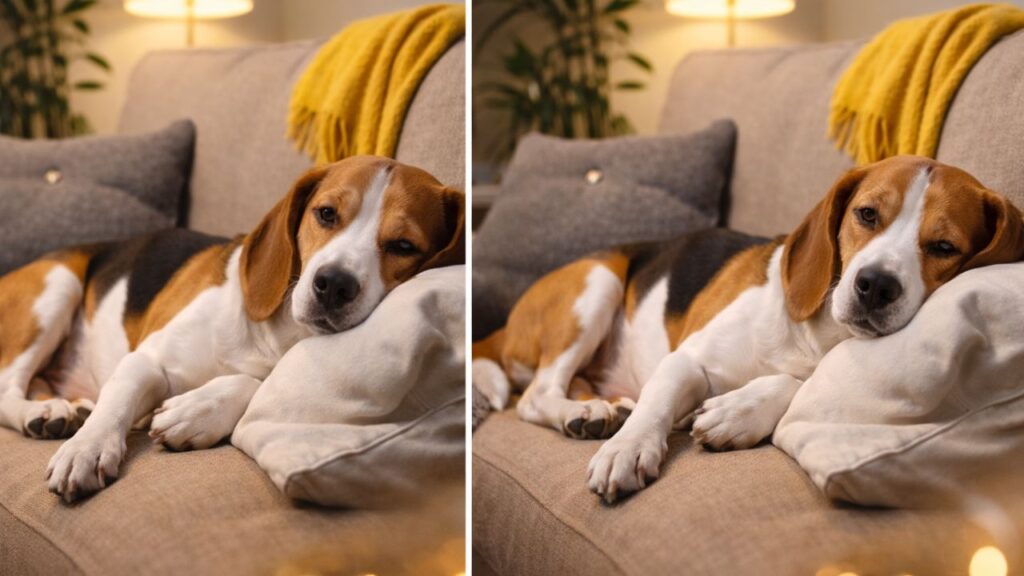
Spot-the-difference puzzles seem easy until you start the timer. In this lazy dog challenge you see two nearly identical cartoon scenes showing a sleepy puppy curled up on a bed in a cozy room with familiar background details like a green armchair, a bright window, toys on the floor and a food bowl nearby. The goal is simple: find exactly three differences in only 10 seconds but the design takes advantage of how human attention actually works. What makes this puzzle so enjoyable is the contrast between comfort & difficulty. The scene feels safe and familiar so your brain quickly decides it’s the same picture twice and then stops making careful comparisons. That’s the trap. To win you need to override that quick assumption & scan with purpose.
Why This Puzzle Feels Harder Than It Looks
Your visual system is designed for speed, not precision. In everyday life, you don’t analyze every detail of a scene—you rely on the overall “gist” to function efficiently. That shortcut works well in real situations, but it’s exactly why subtle changes slip past you in puzzles like this.
When two images look almost identical, your brain leans heavily on prediction. Once the layout feels familiar, it automatically fills in gaps and assumes both images match. Under time pressure, you tend to scan broadly instead of comparing deliberately, which means small changes in color, shape, or count are easy to miss unless your attention lands directly on them.

Emotion plays a role too. Cute or cozy artwork can soften analytical focus because you’re enjoying the scene rather than scrutinizing it. That doesn’t mean you’re bad at puzzles—it means the visual design is doing its job.
The Brain Science Behind Change Blindness
This puzzle is a classic example of change blindness, a well-documented phenomenon in perception research. Studies by psychologist Ronald Rensink and others show that people often miss obvious changes when their attention isn’t focused on the altered area. You can look directly at a detail and still fail to register it if your attention is elsewhere.
This happens because visual features—such as color, shape, and motion—are processed separately and then bound together into objects. When two scenes are nearly identical, your brain binds them quickly and treats them as stable. Only a small portion of the visual field receives high-resolution processing at any moment, controlled by attentional networks.
Working memory is also critical. Spotting differences means holding one image in short-term memory while comparing it to the other. With a strict 10-second limit, that comparison becomes fragile. If your eyes move too quickly, details never get encoded strongly enough to notice what changed.
A Fast Method That Actually Works in 10 Seconds
Random scanning feels productive, but it’s usually inefficient. A structured, almost mechanical approach works far better—even when the image is visually appealing.
Start by dividing the image into clear zones: the top area, the middle focal subject, and the bottom details. Compare one zone at a time from left to right without jumping around. Focus first on likely puzzle targets such as faces, repeated symbols, bright objects, and high-contrast edges.
Use a rapid back-and-forth comparison between the two images so changes appear like a brief “blink.” Slow your eye movements slightly—fast glances skip detail, while controlled scanning reveals edits. This approach lowers cognitive load by reducing how much information you hold in memory at once.
Solution: The Three Differences in the Lazy Dog Images
If time ran out or you want to confirm your observations, here are the three changes hidden in the scene:
The sun in the window has extra rays in the right image. The ball near the bone changes color, appearing multicolored on the left and solid green on the right. One “Z” is missing from the sleep bubbles above the dog’s head in the right image.
None of these changes alter the meaning of the scene. The dog is still asleep, the room still feels cozy, and the layout remains familiar. That’s why your brain is tempted to treat both images as identical.
What Your Result Says—and What It Doesn’t
Finding all three differences quickly suggests strong selective attention and good visual working memory under pressure. These skills transfer well to tasks like proofreading, quality control, interface testing, and any role where small anomalies matter.
Struggling doesn’t mean poor vision or low intelligence. Many people naturally process scenes holistically, focusing on meaning and relationships rather than fine detail. That big-picture style is valuable in strategy, creativity, leadership, and social reasoning.
The key takeaway is attentional flexibility. With practice, you can learn to switch between global viewing and detail inspection, which is why these puzzles become easier over time.
Why These Puzzles Are Still Popular in 2025
In an age of constant scrolling and fragmented attention, short visual challenges offer a simple way to train focus. They’re quick, easy to share, and surprisingly revealing. More importantly, they teach a modern skill: resisting autopilot perception.
To improve, vary the types of puzzles you try. Mix different art styles, grid sizes, time limits, and formats like “find the odd one out.” Consistency matters more than difficulty. Even a few minutes of focused practice each day can sharpen how quickly you lock onto meaningful details.